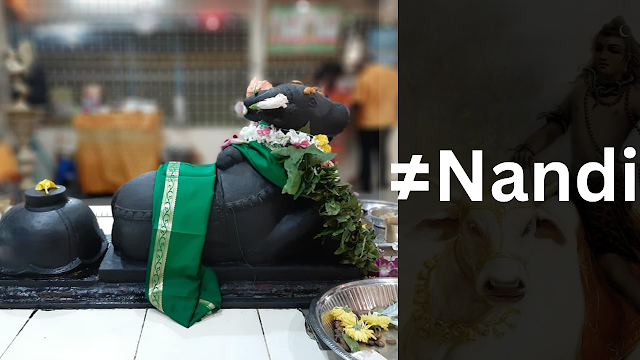
What if I told you that the bull we worship in a Śaiva temple is not Nandi as per Śaiva Tantra? Shocking? Let us see why..
Nandi
Lord Nandi is manifest in the form of Lord Śiva. We refer to adhikāra Nandi as the deity who has the form of Śiva, with Jaṭā Makuṭa (crown of matted hair), Gaṅgā, Ḍamaruka, three eyes, aṅkuśa, and mṛga ( deer )

Lord Nandi is the Pramatha Gaṇa. He holds authority in allowing or disallowing anyone from meeting Lord Śiva. This is why He has the title 'adhikāra.'
He is Śiva-svarūpa, as mentioned. Alternatively, He can also manifest as a deity with a bovine face and a humanoid body (upper limbs, trunk, and lower limbs)

Image: Adhikāra Nandi.
The Kāmikā Āgama, Arcanā Vidhi in fact, describes Nandi's form
नन्दिनं पूर्वदिग्भागे पद्मराग समप्रभम् |
त्रिनेत्रं शूलहस्तं च सौम्यं नागोपवीतिनम्
nandinaṃ pūrvadigbhāge padmarāga samaprabham |
trinetraṃ śūlahastaṃ ca saumyaṃ nāgopavītinam
nandinaṃ — of Nandi
pūrvadigbhāge — in the eastern direction
padmarāga-sama-prabham — shining like the ruby (padmarāga), having a brilliance comparable to a red gem
trinetram — three-eyed
śūla-hastam — holding the trident (śūla) in his hand
ca — and
saumyam — gentle, pleasing, benevolent
nāga-upavītinam — adorned with a serpent as the sacred thread (upavīta)
Meaning: Nandi, positioned in the eastern direction, shines with the radiance of a ruby. He is three-eyed, holds a trident in his hand, is gentle in form, and wears a serpent as his sacred thread.
The deity in the form of bull as a manifest animal form ( with hooves, hump, tail etc) is vṛṣabha.
The paddhati describes Him as such:
वृषो वृषा कृतिस् त्र्यक्शो रुद्रैक गद मानसः
साक्षात् धर्म स्वरूपश्च शुद्ध स्फटिक निर्मलः
vṛṣo vṛṣā kṛtis tryakśo rudraika gada mānasaḥ
sākṣāt dharma svarūpaśca śuddha sphaṭika nirmalaḥ
vṛṣaḥ – He is the Bull
vṛṣā-kṛtiḥ – He whose very actions are dharma; the performer of righteous deeds
try-akṣaḥ – The three-eyed one
rudra-eka-gada-mānasaḥ – Whose mind is fixed only on Rudra; entirely devoted to Rudra alone
sākṣāt dharma-svarūpaḥ – He is the very embodiment of dharma; dharma personified
śuddha-sphaṭika-nirmalaḥ – Pure and flawless like a crystal; immaculate and spotless
Meaning:
He is the Bull, the one who embodies righteousness and acts in righteousness.
He is three-eyed, and his mind remains devoted solely to Rudra.
He is dharma itself in visible form—pure, radiant, and spotless like a clear crystal.
Commentary:
The above mantra is the dhyāna śloka for Vṛṣabha. It describes Him as having three eyes. In a meditative state, His heart is always on Rudra. He is the very manifest form of Dharma. He is Dharma Devatā.
When we hold firm to Dharma, we attain Lord Śiva. This is why we approach Lord Śiva through Vṛṣabha, who is the very embodiment of Dharma.

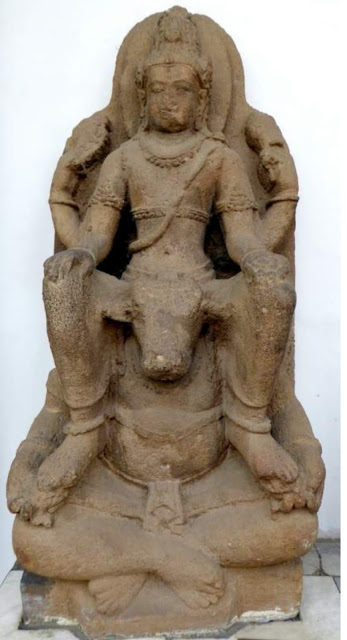
Vṛṣabha Pūja During Pradoṣam

So, it is Vṛṣabha who receives the ritualistic bath during Pradoṣam and not Nandi. This is clearly described in the Śaiva Paddhati (a manual for rituals based on the Śaiva Āgamas).
सर्व विश्व रक्षा करम् धर्मम् वृषभम् प्रथमं यजेत्
sarva viśva rakṣā karam dharmam vṛṣabham prathamaṃ yajet
sarva — all
viśva — the universe / all worlds
rakṣā-karam — the one who grants protection; the protector
dharmam — righteousness / dharma
vṛṣabham — Vṛṣabha (the divine Bull, embodiment of dharma)
prathamaṃ — first, foremost
yajet — one should worship / offer worship
Meaning:
One should first worship Vṛṣabha, the embodiment of dharma and the protector of the entire universe
Commentary:
This verse refers to Vṛṣabha as the one who protects the entire cosmos as Dharma. During Pradoṣa, we first offer our worship to this Vṛṣabha.
Upon performing abhiṣeka, alaṅkāra, and pūjā, we then invoke and worship Lord Śiva between Vṛṣabha's horns.
Video: My student Smt. Kavita reciting the Ṛṣabha Sūkta of Ṛg Veda, which describes Vṛṣabha.
Pañcāvaraṇa Pūjā
Further, in Śaiva Āgama, there is a ritual where we invoke and worship the deities who surround Sadāśiva. These deities are present in different enclosures (āvaraṇa-s), from the closest to the most distal to Sadāśiva.
Nandī is worshiped in the 3rd āvaraṇa. He is part of the Śiva gaṇeśvara-s. He stands at the eastern direction. Vṛṣabha is also worshiped in the 3rd āvaraṇa. He however, is invoked in the western direction. This concludes that they are two different deities.
Also Read:

No comments:
Post a Comment