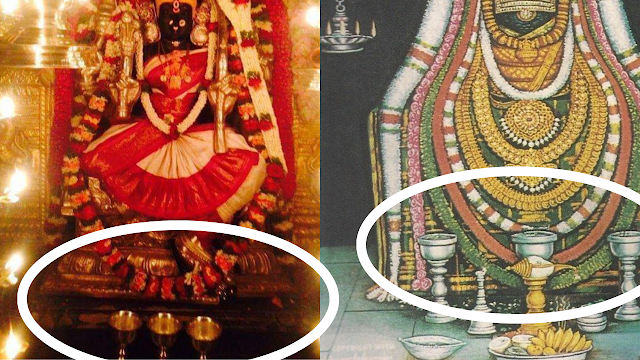
(1) Pādyam
The first cup represents pādya. This is the water used to wash the feet of the Lord. It represents the respectful reception of the deity as an honoured guest. This pādya pātram( cup ) is filled with water mixed with sandal paste and uśīra ( veṭṭiver ), as instructed in the Kāmika āgama.
Kāmika āgama, arcana vidhi, verse 207:
प्रक्षाल्य पाद्यपात्रं तु गन्धतोयेन पूरयेत्॥ उशीरं चन्दनं चैव पाद्ये तु परिकल्पयेत्।
prakṣālya pādyapātraṃ tu gandhatoyena pūrayet॥ uśīraṃ candanaṃ caiva pādye tu parikalpayet।
Word to word meaning:
प्रक्षाल्य (prakṣālya): having washed/cleansed
पाद्यपात्रं (pādyapātraṃ): the foot-washing vessel
तु (tu): indeed/then (used as a particle to indicate emphasis)
गन्धतोयेन (gandhatoyena): with scented water
पूरयेत् (pūrayet): should fill
उशीरं (uśīraṃ): veṭṭiver (a grass known for its aromatic roots)
चन्दनं (candanaṃ): Sandalwood
च (ca): and
एव (eva): indeed/only
पाद्ये (pādye): in the foot-washing [water]
तु (tu): then/indeed
परिकल्पयेत् (parikalpayet): should prepare/arrange
(2) ācamanam
It is the water offered for ritual sipping or cleansing of the mouth. This pātra is filled with water mixed with camphor in the measure of 3 pala-s, broken leaves and kusḥṭhaka. The hṛdaya mantra is recited along this.
Kāmika āgama, arcana vidhi, verse 208:
तद्वदाचमनीयार्थं तत्पात्रं परिकल्पयेत्॥ पलत्रयं च कर्पूरं तृटीपत्रं च कुष्ठकम्।
tadvadācamanīyārthaṃ tatpātraṃ parikalpayet॥ palatrayaṃ ca karpūraṃ tṛṭīpatraṃ ca kuṣṭhakam।
tadvat (तद्वत्) - in that way, similarly
ācamanīyārthaṃ (आचमनीयार्थं) - for the purpose of sipping water (ācamanīya)
tatpātraṃ (तत्पात्रं) - that vessel
parikalpayet (परिकल्पयेत्) - should prepare/arrange
palatrayaṃ (पलत्रयं) - three Palas (a vedic measure of weight )
ca (च) - and
karpūraṃ (कर्पूरं) - camphor
tṛṭīpatraṃ (तृटीपत्रं) - broken leaves
ca (च) - and
kuṣṭhakam (कुष्ठकम्) - Kuṣṭha ( Indian Costus, Saussurea lappa )
(3) Arghyam
This is a respectful ceremonial offering of water, usually enriched with auspicious substances. There are 8 special dravya-s which are added into this arghya pātram.
विशेषार्घ्यं ततः कुर्यात् यवसिद्धार्थकाक्षतैः।
अद्भिस्तिल कुशाग्रैश्च क्षीरपुष्पैः समन्वितं॥
viśeṣārghyaṃ tataḥ kuryāt yavasiddhārthakākṣataiḥ।
adbhistila kuśāgraiśca kṣīrapuṣpaiḥ samanvitaṃ॥

beautiful explanation
ReplyDeleteno one explained this before thanks for your explanation
ReplyDelete